A theological basis
to clerical celibacy

A theological basis to clerical celibacy

Professor Paul Mullen is probably very gifted in Forensic Health, but his grasp of Catholic theology ain’t great.

He has suggested that clerical celibacy is a discipline not a dogma. So far so good.

He says clerical celibacy has financial implications:

“I’ve have heard a Catholic bishop say that the reason celibacy is maintained is that they could not afford to pay priests, they couldn’t afford to pay them pensions, they couldn’t afford to pay them enough if they had a wife and children.”

Yep. Wouldn’t dispute that.

But according to the press, he also says “celibacy has no basis in theology.” (Now I don’t know if he actually said that. It’s only what the media has reported. They’re not always the same thing.)

This is wrong. There is a theological basis to clerical celibacy. And even if Pope Francis relaxed the requirement of clerical celibacy tomorrow, that theological basis is not negated.

“For there are eunuchs who have been so from birth, and there are eunuchs who have been made eunuchs by men, and there are eunuchs who have made themselves eunuchs for the sake of the kingdom of heaven. He who is able to receive this, let him receive it.” (Mt 19:12.)

These are our Lord’s own words. So to start with, we can dispense with the idea that clerical celibacy is unnatural and displeasing to God (or at best, God is indifferent). Jesus himself sets us straight. “Anyone who is able to live this calling, live it!”

Jesus himself was a eunuch for the sake of the kingdom. His celibacy was counter-cultural. A rabbi was expected to serve God by marrying and bringing up children. But our Lord didn’t do this. Why?

For starters, Jesus knew his mission would culminate in premature death. How could he, in good conscience, expose a wife and children to destitution? (Financial implications again! I’ll come back to that.)

But more importantly, our Lord’s celibacy also speaks to the very meaning — the very theology — of marriage, not to mention ecclesiology (the theology of the Church).


1. Theology of marriage.

Man alone is incomplete. Woman alone is incomplete. But in marriage, the two become one and they are more complete. The very etymology of “sex” speaks to this. Put another way, man alone is an image of God. Woman alone is an image of God. Man and woman together is a more perfect image of God.

“So God created man in his own image, in the image of God he created him; male and female he created them.” (Gen 1:27)

The nuptial union signifies the promise which awaits each of us in eternity, when our incompleteness is perfectly resolved by our union with God. As St Augustine famously observed, “You have made us for yourself, O Lord, and our heart is restless until it rests in you.”

Jesus, of course, is an exception to this. Unlike the average Adam, Jesus is already complete. Marriage cannot complete him, because he is already the perfect image of God. Jesus is God. It could be argued that it wouldn’t make theological sense for Jesus to marry.

2. Theology of the Church.

Jesus’ celibacy also has ramifications for the Church. Christ is the bridegroom; the Church is his bride. He consecrated himself to all of us equally, which precludes an exclusive married relationship. In the same way, priests who are celibate consecrate themselves to the Church, which precludes an exclusive married relationship.

Moreover, “eunuchs for the kingdom” — be they clerical or lay, male or female — witness to God’s love just as husbands and wives witness to God’s love. Marriage is sacramental. The love and shared life of spouses is a material expression of the nuptial relationship between Christ and his Church. Celibacy is not sacramental. But it is a prophetic sign of what awaits us in eternity.

So it seems our Lord’s celibacy had practical implications, and theological ones. As it is for Jesus, so it is for the Church. There are financial implications in the discipline of clerical celibacy. But there is also a theological basis.

At its most basic, and speaking personally now, I’m celibate because Jesus was celibate.

The Victorian Parliamentary Inquiry

Incidentally, Professor Mullen’s remarks were made at a hearing of the Victorian Parliamentary Inquiry into Child Abuse. I attended one of these hearings a few weeks ago. I’m glad I did. It’s important, I think, to listen to abuse survivors. Not only in the name of justice, but also in the name of healing. Survivors have insights which can heal the whole Church, not to mention wider society.

I too easily tire of the media coverage of the clergy abuse scandal. The darkness is overwhelming. It almost threatens to choke one’s faith in goodness and humanity.

Attending the Inquiry itself was a different sort of experience. It actually increased my faith in goodness and humanity. Hearing the stories was still torturous, but hope prevailed. The courage of survivors and whistle-blowers evoked the words of St John.

The light shines in the darkness, and the darkness has not overcome it. (Jn 1:5)

Fr Kevin Dillon & the Victorian Parliamentary Inquiry

Fr Kevin Dillon & the Victorian Parliamentary Inquiry

Father Kevin Dillon supports the Geelong Cats to a fault. And his suggestion that popes should be elected for fixed terms strikes me as a disastrous invitation to conciliarism. So I certainly don’t agree with everything he says.

However, I think his submission to the Victorian Parliamentary Inquiry into the handling of child abuse commands not only respect, but also admiration. It adds the voice of a pastor to the public debate. Moreover, the fact that he received a standing ovation after his testimony last week indicates that his is a voice which is loved and appreciated by survivors of sexual abuse.

It’s probably not prudent for me to comment in detail on his submission, but nor is it necessary. It speaks for itself. So go ahead and read it yourself!

Homilies in response
to the Royal Commission

Homilies in response to the Royal Commission

Since my recent post on the clerical abuse scandal, I have been alerted to good homilies on the issue which were delivered last November, when the Royal Commission was announced.

I was on holidays at the time, so although I watched the occasional press conference, I wasn’t plugged into the blogosphere and related media. I probably wasn’t even aware of the low morale of the time. That’s the context of these homilies.

The first homily was delivered by Fr Greg Morgan, a Sydney priest who like me was ordained in 2011. Unlike me, he is still in his mid-twenties, and I think he currently holds the title of ‘Australia’s youngest priest.’

His homily is something of a rallying cry. It’s not my style, but I like it nonetheless. In fact, there is only one major point on which I would diverge. At 5:40, Fr Greg declares “I love the Catholic Church not for any bishop or priest or layperson, but because I love Christ.” That’s probably sounder theology than my own, but to be honest, I love the Church not just for Jesus Christ, but also for her saints. I never tire of reading the lives of canonised saints. And I’m also edified by “living saints” — that is, people whom I meet whose faith and holiness is almost tangible. It is largely (though not exclusively) through them that I have come to love Christ and his Church.

This is the single most compelling reason I know for all of us to aspire to sanctity. So that each of us can, in a similar way, attract others to Christ. (It’s also why even the most private sin committed by a Christian damages the whole Church.)

In the end, it’s only a minor divergence, since Fr Greg finishes his homily by expounding the universal call to holiness.

The other homily is quite different in style. It’s much more sober for a start. That should come as no surprise to anyone who knows Fr Justin, whose comments on this blog share the same sobriety, and whose clear thinking betrays his extensive background in philosophy. I think philosophers tend to be more sober and cautious in their expression, by training if not by temperament.

A parishioner requested a copy of this homily after it was delivered, and from there it quickly circulated through various online channels. I received it three times in 24 hours from independent sources.

HOMILY, 33 ORD B, 18-11-12

Both these homilies serve as a counterbalance to my previous post. I like them both. But that’s not a disendorsement of Fr Rolheiser’s article. These homilies do not contradict his article. In fact I think they complement it, insofar as they elaborate upon a very complex issue.

How ought we respond to
sexual abuse in the Church?

How ought we respond to sexual abuse in the Church?

January’s edition of Quadrant has an interesting article by a lapsed Catholic about the clerical abuse scandal: ‘Father Scapegoat,’ by Joe Dolce.

(That link will take you to the article in its entirety, which surprises me. I thought you’d have to buy the magazine! It’s worth subscribing to Quadrant. It’s good for the life of the mind — your own specifically, and Australia’s more broadly.)

Anyway, Joe Dolce’s missive teems with insights. His recollection of prurience in the confessional is mortifying, and thankfully alien to my own experience. His perception of the Catholic priesthood’s “unique spiritual cul-de-sac” is enlightening. And his exposition of the sexual abuse of children in contemporary society is horrifying.

The article makes excellent reading, and I recommend it to everyone.

But I take issue with Dolce’s critique of the Church’s media response. I agree with him that the press has engaged in an irrational and dishonest campaign against the Church. I get what people mean when they suggest “the Church should thank the media.” Without external pressure, internal reform seldom occurs. It’s impossible to thank the media though, when its anti-Catholic prejudice blinds it to abuse occurring elsewhere, and hinders responsible debate about where popular culture has gone wrong.

The pedophile priest, Dolce writes, has become the scapegoat. All our guilt and blame is projected onto him (and the Catholic Church by association and implication), and everyone else is absolved. Dolce cites a slew of studies which demonstrate that the problem is much larger than the Church. And he wonders why more Catholics don’t speak up and refute media distortions.

I think there are a few answers to that. I think some Catholics are so mortified by the scandal, that they now tune out of the media coverage, and hope for the day the storm passes. And I think many Catholics are mortified by the hierarchy’s inadequate response to victims, and are loathe to defend the Church’s record on this issue, even in the face of media mendacity.

And then there is Dolce’s appeal to a martyr complex:

Unfortunately, there is also a historical proclivity amongst some Catholic clergy—an almost suicidal romantic yearning—for martyrdom, in the spirit of the martyrdom of Jesus. The contemporary Catholic saint Maximilian Kolbe once said that he looked forward to being sent to “heathen” Japan where if priests were fortunate they might be martyred for their beliefs. To me, that is passive and cowardly. Real martyrdom would be more along the path of the social activist, the path that Jesus actually walked, speaking out against the lie and taking whatever consequences.

Dolce’s greatest strength is also his greatest weakness. His outside view affords him refreshing insights into the popular perception of the celibate priest. But it prevents him from understanding an authentically faithful response to the Gospel.

Just such an account is provided, however, by Fr Ron Rolheiser’s ‘On Carrying A Scandal Biblically.’ (A survivor of sexual abuse read this article and recommended it to me. They quibbled over minor points, but from their perspective the sum of it is excellent.)

Rolheiser suggests that the Church’s response to the sexual abuse scandal should be focused exclusively on healing:

To carry this scandal biblically means too that healing, not self-protection and security, must be our real preoccupation. Sometimes for bishops, provincials, religious superiors, and church officials there’s a real (and understandable) danger of losing perspective in the face of accusations of sexual abuse. Many times, in fact, we have lost perspective.

In the vortex this crisis, what has to be our primary preoccupation? To protect the innocent and to bring about healing and reconciliation. Everything else (worries about security, lawsuits, and the like) must come afterwards.

Rolheiser echoes Dolce’s claim that the pedophile priest, even the Church, has become a scapegoat. But where Dolce sees an outrageous injustice which must be put right, Rolheiser sees an outrageous injustice and prophetic opportunity:

Right now priests represent less than one per-cent of the overall problem of sexual abuse, but we’re on the front pages of the newspapers and the issue is very much focused on us. Psychologically this is painful, but biblically this is not a bad thing: The fact that priests and the church have been scapegoated right now is not necessarily bad. If our being scapegoated helps society by bringing the issue of sexual abuse and its devastation of the human soul more into the open, than we are precisely offering ourselves as “food for the life of the world”, and we, like Jesus in his crucifixion, are helping to “take away the sins of the world.”

. . This is not a distraction to the life of the church, it’s perhaps the major thing that we need to do right now for the world and our culture. There are very few things that we are doing as Christian communities today that are more important than helping the world deal with this issue. If the price tag is that we are humiliated on the front pages of the newspapers and that the Anglican, United, and Roman Catholic Churches of Canada end up financially bankrupt, so be it. Crucifixions are never easy and they exact real blood! It might well be worth it in the long run if we can help our world come to grips with this.

I can see why the world might call this a martyr complex. But it strikes me as profoundly supernatural in its outlook. Which is another way of saying that far from being passive and cowardly, it is good and true.

St Josemaría Escrivá and me

St Josemaría Escrivá and me

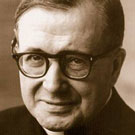
Today was the feast day of a saint who is very dear to me. In St Josemaría Escrivá I see an inspiring model for current-day priests, engaging with a secular and in some respects ‘post-Christian’ culture.

Well, I would say that, wouldn’t I?, since I am a member of Opus Dei. But that’s confusing the cart and the horse. I was attracted to Opus Dei only after reading and coming to love St Josemaría.

When I left home at 18 to study in Melbourne, I was both idealistic and sceptical. At 18, who isn’t? I was attracted to Christ and his Gospel, but I was disillusioned with a Church which was bereft of authority. The scandal of clerical abuse and its cover-up was in the headlines and on my mind, and lacklustre liturgy and preaching didn’t help either.

My Catholic identity was tenuous. I may have been easy prey for the evangelical Christians on campus, except that my childhood love of the saints — St Thérèse especially — had not left me. The distant figure of Archbishop Pell also commanded respect, if only because he spoke boldly and against the tide, and he had been chaplain in my first years at primary school. Still, I did not know personally any priests, nor did I want to. I doubt I’d ever have changed denominations, but I was probably on track to become a “mere Christian,” cultivating a personal spirituality and private prayer life, independent of “organised religion.”

Nonetheless, one’s first year at university is a time to explore everything. I attended the meetings and functions of all sorts of clubs and societies, from the fickle (the Chocolate Appreciation Society; the Free Beer Society) to the radical (the Socialist Alliance; the Citizen’s Electoral Council). I watched the Students for Christ debate the Humanists, and I joined an evangelical Christian book club. An invitation to dinner at an Opus Dei study centre was just one more function to add to the list. I was supposed to attend a preached meditation (whatever that was), but I was running late, and arrived just in time for Simple Benediction. The presence of a fully fledged chapel in a suburban house — not to mention the unfamiliar sight of a priest in cassock and the alien sound of Latin (the ritual concluded with the Salve Regina) — quickly convinced me that I had encountered a cult which was far removed from mainstream Catholicism. Nonetheless, I enjoyed the conversation and debate at dinner, which covered such diverse topics as the best imported beer, the Australian wheat price, and the cultural influence of Peter Sellers. Much to my surprise, religion wasn’t mentioned at all.

Subsequent invitations to meditation and dinner were gladly accepted, and I was impressed by the spiritual content of the preaching, and the easygoing warmth of the rest of the evening. This stood in stark contrast to my encounters at the evangelical book club, which were terminated after my Catholic background was discovered, and I was forcefully and repeatedly subjected to anti-papist rants.

Still, I sustained a polite disinterest in Opus Dei until I was given a copy of The Way, a small book of spiritual maxims which made “Father Joseph Mary Escriva” famous decades before anyone had heard of Opus Dei. Several weeks passed before I picked it up, but when I did I couldn’t put it down. Its insights startled me. It was as though Josemaría had read my heart and mind, and spoke directly to me. Moreover, there was a warmth and attractiveness to his style which had me looking for more.

It all happened quite gradually of course, but looking back, I think it’s fair to say that St Josemaría taught me to love the Church just as I already loved Jesus Christ. Thus this video — which I had not seen before today — is a very apt illustration of that style:

I think it’s also fair to credit St Josemaría with my priestly vocation. Years before I thought of becoming a priest, I thought of becoming a saint. That has its roots in my discovery of St Thérèse’s “Little Way” at eight or nine, and Mum’s assurance that God calls us all to be saints. This is St Josemaría’s message too, and I was able to discern a priestly calling only after adopting the sort of prayer life he recommended for lay apostles.

There Be Dragons is an average movie of uneven quality, but it does a very good job depicting St Josemaría’s vision. I’m proud and humbled to call myself one of his spiritual children.