The thorn in Paul’s flesh

The thorn in Paul’s flesh

What was that thorn in St Paul’s flesh which we heard about at Mass yesterday?

Just to jog your memory:

I was given a thorn in the flesh, an angel of Satan to beat me and stop me from getting too proud! About this thing, I have pleaded with the Lord three times for it to leave me.

(2 Cor 12:7-8)

St Augustine suggests Paul was referring to a physical affliction — perhaps the same “bodily ailment” which Paul mentions in his Letter to the Galatians. (Gal 4:13) St John Chrysostom argues that Paul was referring to the religious persecutions he endured. St Gregory the Great speculates that the thorn may be a temptation which Paul struggled with — anything from lust to greed to an addiction. Or maybe St Paul was reflecting on his fiery temperament, which I’ve blogged about before.

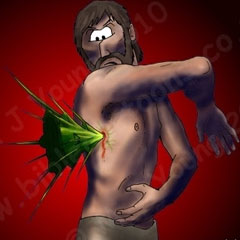
No speculation on the thorn in Paul’s flesh is complete without mention of cartoonist Tim Davis’ theory. Its implausibility in no way diminishes it hilarity:

St Paul’s terms are general and ambiguous, but there are a few things we can ascertain about this thorn. Firstly, it’s not only painful to him, but humiliating. Secondly, it’s not from God. We could go as far as to say it’s evil — Paul attributes his thorn to Satan. Thirdly, and most importantly, this unwanted and humiliating evil becomes a conduit of God’s grace.

We have thorns of our own — weaknesses, vices, addictions — which we can beg God to take away. And the good Lord  probably says to us what he said to Paul. “My grace is enough for you.”

But can we respond as Paul responds? “I am quite content with my weaknesses . . . For it is when I am weak that I am strong.”

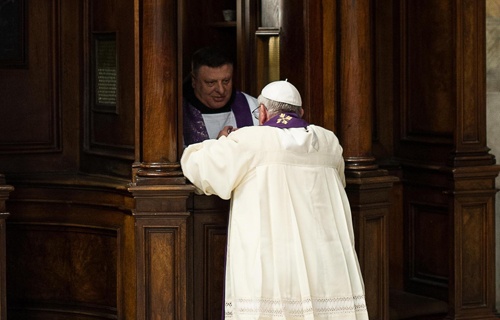
Sacramental confession helps. How often shame and embarassment discourage us from confessing our sins. But it is precisely through confession that the Lord heals us of that shame and embarrassment.

When such thorns are hidden, they possess us and deprive us of peace. But when they are named, they lose their power and the Lord’s healing work flourishes.

It’s a very humble soul who can write “I shall be very happy to make my weaknesses my special boast, so that the power of Christ may stay over me.” This is the stuff of saints! The stuff of spiritual childhood! (Same thing.)

St Paul, pray for us!

Confession and unity of life

Confession and unity of life

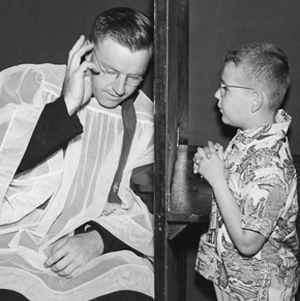
Sacramental confession is a wonderful thing. I say that as a penitent, not as a confessor. As a matter of fact, since becoming a confessor, I’ve learned that ministering the sacrament takes a lot, and gives little.

Not that going to confession is much fun either. It might be likened to a trip to the dentist. Something to plan ahead of time and endure for its duration, only to bask in the good it brings in the end.

Sadly, becoming a confessor has restricted my freedom to blog about confession. It doesn’t have to be this way I suppose, but I’m so wary of the sacramental seal, that I believe it’s prudent to say little.

In my second week as a priest, I heard confessions one evening, and then offered a weekday mass the following morning. As I distributed communion I recognised a vaguely familiar face. After mass, a queue formed to receive the personal blessing of the newly ordained priest. I asked the familiar face if we had met.

“You heard my confession last night Father. Remember?”

I didn’t as it happens — until that moment. And then I realised with horror that the homily I had preached at mass was very similar to the “homiletto” I delivered in the confessional the night before. I hoped the penitent didn’t think I was referring to them as I preached my homily!

No harm was done on that occasion, but I learnt a valuable lesson. The seal of confession is such that I must be attentive even to perceptions of its violation. So the best course of action is not to blog about confessions.

But I can link to a confession-themed post by my favourite blogger! Lindenman has the fresh eyes of an adult convert, and his insights on confession are both mature and light-hearted.

I think it’s good to be light-hearted, especially about our personal failings. The devil takes himself too seriously. The saints avoid that error.

All of this is pertinent, in light of the scandal in Parramatta. The central issue in that case is, I think, unity of life. I can’t imagine Fr Lee “set out” to do what he did. I can well imagine he got to where he got by a series of small steps which slowly embroiled him deeper and deeper into a double life.

We’re all vulnerable to that. God calls us into the light, but the shadows are always beckoning. One of the greatest means to unity of life, I think, is regular confession. Please God we might all frequent this sacrament with a holy maturity and an appropriate lightness of heart.